Appendix A: Contract Analysis
Working Arrangements for Registered Massage Therapists in British Columbia
Appendix A: Contract Analysis Summary
Working Arrangements for Registered Massage Therapists in British Columbia
The observations below are presented for consideration in relation to commonly used criteria distinguishing independent contractors from employees.
Prepared by Jennifer Slauenwhite, RMT
Updated: May 9, 2026
Purpose
This appendix summarizes commonly observed structural features in agreements used between Registered Massage Therapists (RMTs) and clinic operators in British Columbia.
These observations are based on a review of multiple agreements currently in use across clinic settings and are presented to support consideration of how these working arrangements function in practice.
These observations do not apply to all forms of independent practice. Some RMTs may operate legitimate independent businesses with direct control over their scheduling, fees, patient relationships, and operational decisions. The concerns outlined here relate specifically to clinic-based arrangements where operational control and practitioner independence may not align clearly.
Across the agreements reviewed, consistent patterns emerge in how scheduling, fees, patient relationships, and operational processes are structured. These patterns may have implications for:
practitioner independence
workplace safety and reporting pathways
visibility of working conditions within the regulatory framework
This appendix is intended to support analysis of whether current working arrangements align with commonly applied distinctions between independent contractors and employees, as well as broader considerations related to accountability and system-level oversight.
Source Material
This analysis is informed by a review of multiple clinic agreements in use within British Columbia, including:
Agreements from local multidisciplinary and massage therapy clinics
A standardized contract template developed by Registered Massage Therapists' Association of British Columbia
These documents reflect commonly used models within the profession.
Evidence Note
This analysis is based on a review of multiple clinic agreements currently in use within British Columbia, including both independently developed contracts and standardized templates.
The observations presented reflect consistent structural features identified across these agreements.
Identifying details have been removed, and practitioner accounts have been anonymized, to protect individuals from potential professional or financial retaliation.
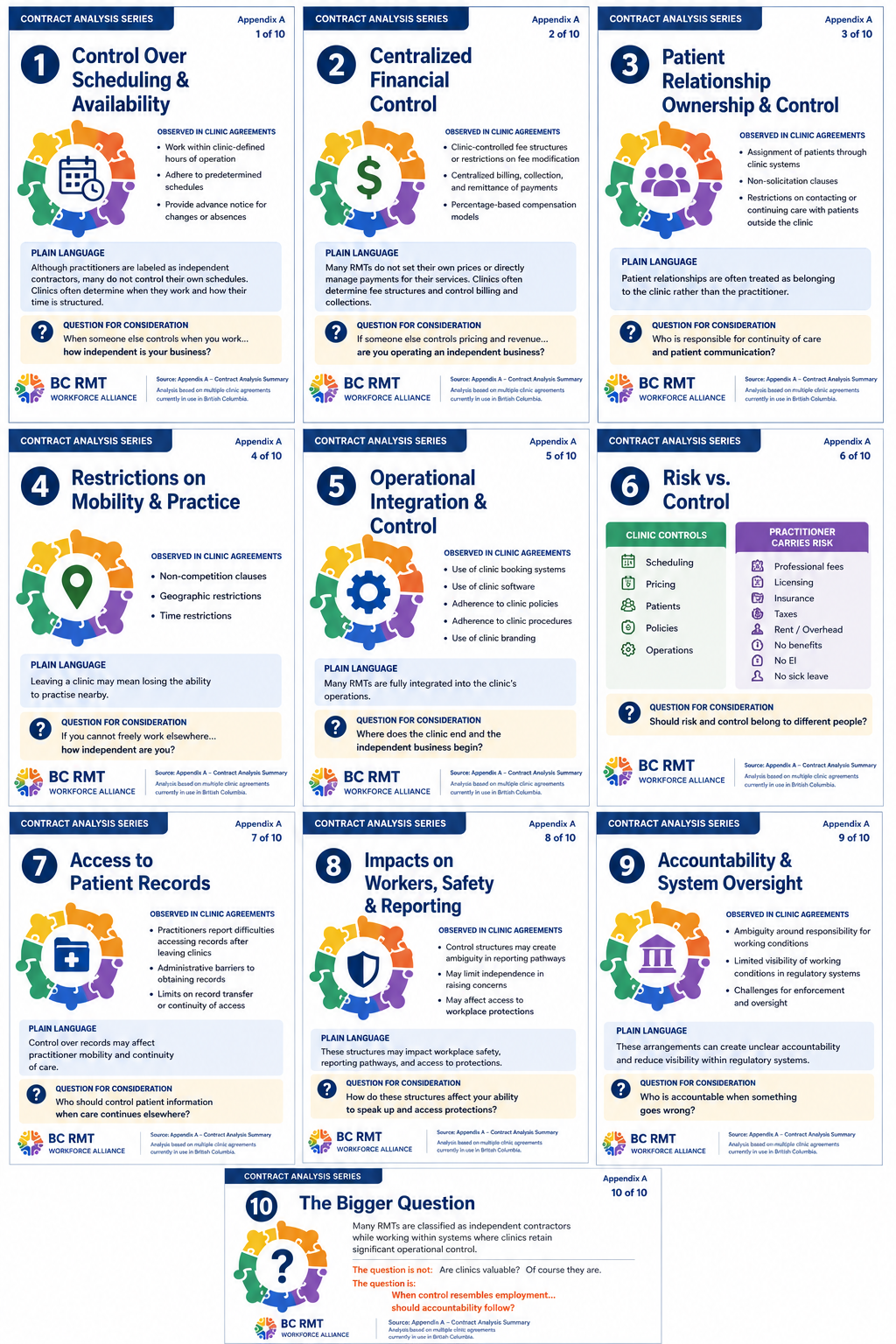
Summary of Observed Structural Features
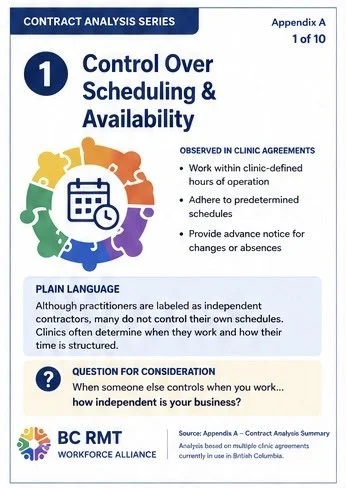
1. Control Over Scheduling and Availability
Clinic-directed scheduling structures may also influence workload pacing, appointment density, and opportunities for recovery between treatments, which may have implications for practitioner fatigue, injury risk, and occupational sustainability.
Agreements commonly require practitioners to:
Work within clinic-defined hours of operation
Adhere to predetermined schedules
Provide advance notice for changes or absences
This limits independent control over when services are provided, appointment.
Regulatory Implication:
May limit practitioner autonomy and create ambiguity regarding responsibility for workplace conditions and reporting obligations.
Potential relevance: May indicate a level of control over work consistent with characteristics typically associated with employment relationships.
Plain Language: What This Means
Although practitioners are labeled as independent contractors, many do not control their own schedules. Clinics often determine when they work and how their time is structured.
In most industries, when a worker does not control their schedule, they are typically considered an employee rather than an independent contractor.
This mismatch can affect access to workplace protections and may create confusion about who is responsible for working conditions.
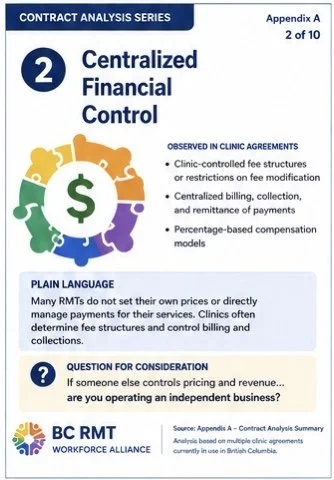
2. Centralized Financial Control
Typical provisions include:
Clinic-controlled fee structures or restrictions on fee modification
Centralized billing, collection, and remittance of payments
Percentage-based compensation models
This places financial control within the clinic rather than with the individual practitioner.
Regulatory Implication:
May indicate reduced independence and contribute to unclear accountability structures within the working relationship.
Potential relevance: May limit the practitioner’s ability to operate as an independent business entity.
Plain Language: What This Means
Many RMTs do not set their own prices or directly manage payments for their services. Clinics often determine fee structures and control billing and collections.
In most industries, independent contractors are expected to set their own rates and manage their own revenue. When these functions are controlled by the clinic, it raises questions about whether the practitioner is operating an independent business.
This structure may reduce financial independence and create unclear lines of accountability within the working relationship.
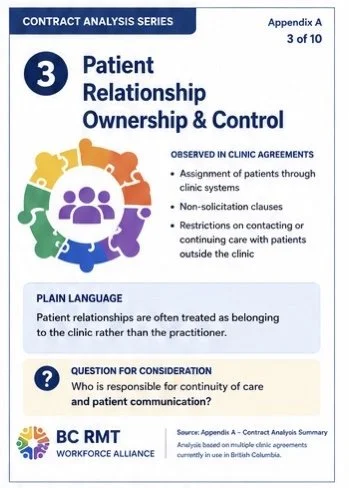
3. Patient Relationship Ownership and Control
Agreements frequently include:
Assignment of patients through clinic systems
Non-solicitation clauses
Restrictions on contacting or continuing care with patients outside the clinic
These provisions indicate that patient relationships are often treated as belonging to the clinic.
Regulatory Implication:
May limit practitioner control over patient relationships and continuity of care, while also contributing to ambiguity regarding responsibility for patient communication, record access, and follow-up in the context of clinical or safety-related concerns.
Potential relevance: May restrict the ability to establish an independent client base, which is typically associated with contractor status.
Plain Language: What This Means
Patient relationships are often treated as belonging to the clinic rather than the practitioner. RMTs may be restricted from contacting patients or continuing care outside of the clinic.
In most industries, independent contractors are responsible for building and maintaining their own client base. When a worker cannot independently manage those relationships, it suggests a level of control more consistent with an employment relationship.
This can affect continuity of care for patients and limit practitioner autonomy in managing treatment relationships.
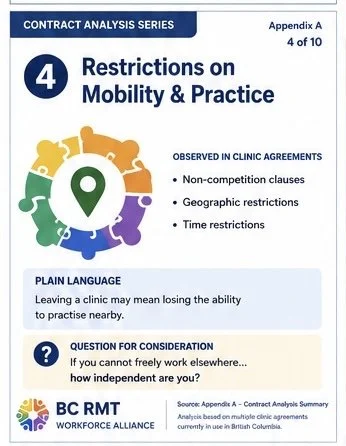
4. Practitioner Mobility Restrictions
Common features include:
Geographic non-competition clauses
Time-based restrictions following termination
Limitations on practicing within defined proximity to the clinic
These provisions affect practitioner mobility and ability to establish independent practice.
Regulatory Implication:
May restrict practitioner mobility and influence decision-making around exiting workplace environments, which may contribute to underreporting of workplace concerns and limit the flow of information relevant to system-level risk identification.
Potential Relevance to Classification Considerations:
May restrict the practitioner’s ability to operate as an independent business by limiting where and how they can provide services following termination, which may be inconsistent with the level of autonomy typically associated with independent contractor status.
Plain Language: What This Means
Some agreements restrict where an RMT can work after leaving a clinic, including geographic limits or time-based restrictions.
In most industries, independent contractors are generally free to offer their services wherever they choose. When a worker is restricted from working in certain areas or settings, it limits their ability to operate as an independent business.
These restrictions may also make it more difficult for practitioners to leave workplace environments, including those where concerns about safety or working conditions may exist.
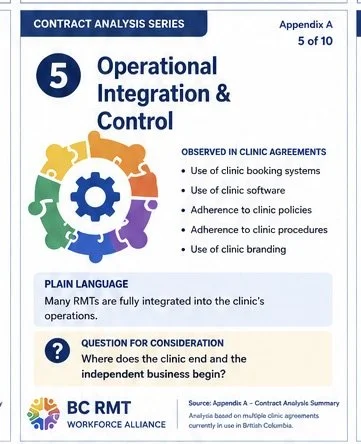
5. Operational Integration and Administrative Control
Practitioners are typically required to:
Follow clinic policies and procedures
Use clinic systems for booking, billing, and communication
Participate in administrative processes or meetings
Follow clinic-directed environmental, sanitation, equipment, or product-use procedures
This reflects a high degree of integration into clinic operations.
Regulatory Implication:
May consolidate operational control within clinic structures, potentially reducing transparency regarding lines of professional accountability and limiting independence in administrative, environmental safety, and reporting processes.
Potential Relevance to Classification Considerations:
May indicate a high degree of integration into the clinic’s business operations, where services are delivered within clinic-controlled systems and processes, a feature more commonly associated with employment relationships than independent business activity.
Plain Language: What This Means
RMTs are often required to follow clinic policies, use clinic systems for booking and billing, and participate in administrative processes. Their work is closely integrated into the clinic’s operations.
In most industries, independent contractors typically operate using their own systems and processes, maintaining separation from the business they contract with. When a worker is fully integrated into an organization’s operations, it more closely resembles an employment relationship.
This level of integration may reduce independence and make it difficult to distinguish where professional responsibility, workplace safety responsibility, and organizational control begin and end.
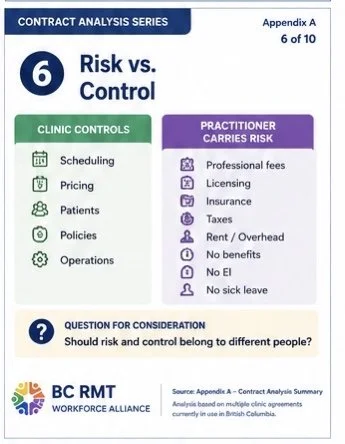
6. Economic Structure and Allocation of Risk
Practitioners are generally responsible for:
Payment of rent or percentage-based fees regardless of patient volume
Professional expenses (licensing, insurance, continuing education)
Operating costs associated with their practice
Clinic compensation structures may incentivize high appointment volume or dense scheduling patterns, while practitioners remain responsible for the physical and psychological demands of care delivery.
At the same time, access to employment-related benefits or protections is typically not provided.
Regulatory Implication:
May indicate a transfer of financial and operational risk to practitioners without corresponding control, contributing to unclear accountability structures and potentially influencing reporting behavior or workplace decision-making.
Potential Relevance to Classification Considerations:
May reflect a transfer of financial risk to practitioners without corresponding control over key aspects of the business (e.g., pricing, scheduling, patient access), which may be inconsistent with typical independent contractor models where risk and control are more closely aligned.
Plain Language: What This Means
RMTs are often responsible for paying fees or rent and covering professional expenses, regardless of how many patients they see. At the same time, they typically do not receive benefits or protections associated with employment.
Compensation models based on treatment volume and centralized clinic-controlled billing may create incentive structures that influence workload pacing, practitioner autonomy, and care delivery patterns.
In most industries, independent contractors assume financial risk but also retain control over key aspects of their business, such as pricing, scheduling, and client access. When risk is transferred to the worker without corresponding control, the arrangement may not align with typical contractor models.
This imbalance may influence decision-making around workload, reporting concerns, or remaining in a workplace.
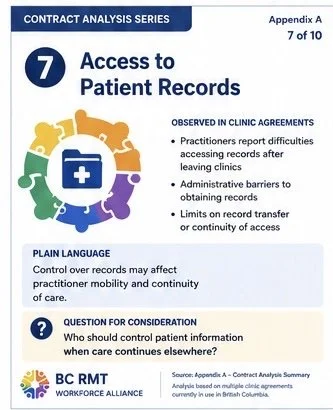
7. Barriers to Record Access and Continuity of Care
Anecdotal reports from practitioners suggest challenges related to:
Accessing patient records upon leaving a clinic
Navigating administrative or financial barriers to obtaining records
Perceived or reported legal or administrative pressure associated with leaving or continuing care independently
These reports highlight potential uncertainty regarding:
Custodianship of clinical records
Continuity of patient care
Practitioner mobility between workplaces
Regulatory Implication:
May restrict practitioner mobility and influence decision-making around reporting or exiting workplace environments, potentially contributing to underreporting of workplace concerns and limiting the flow of information relevant to system-level risk identification.
Potential Relevance to Classification Considerations:
May limit the practitioner’s ability to independently manage client relationships and continuity of service, which is typically a defining feature of operating an independent practice.
Plain Language: What This Means
Some practitioners report difficulty accessing patient records when leaving a clinic or experience barriers when attempting to continue care independently.
In most industries, independent practitioners are responsible for maintaining their own records and client relationships. When access to records is restricted or controlled by another party, it limits the ability to function independently.
This can disrupt continuity of care for patients and may discourage practitioners from leaving or raising concerns, particularly if doing so affects their ability to continue treating their patients.
Key Observation
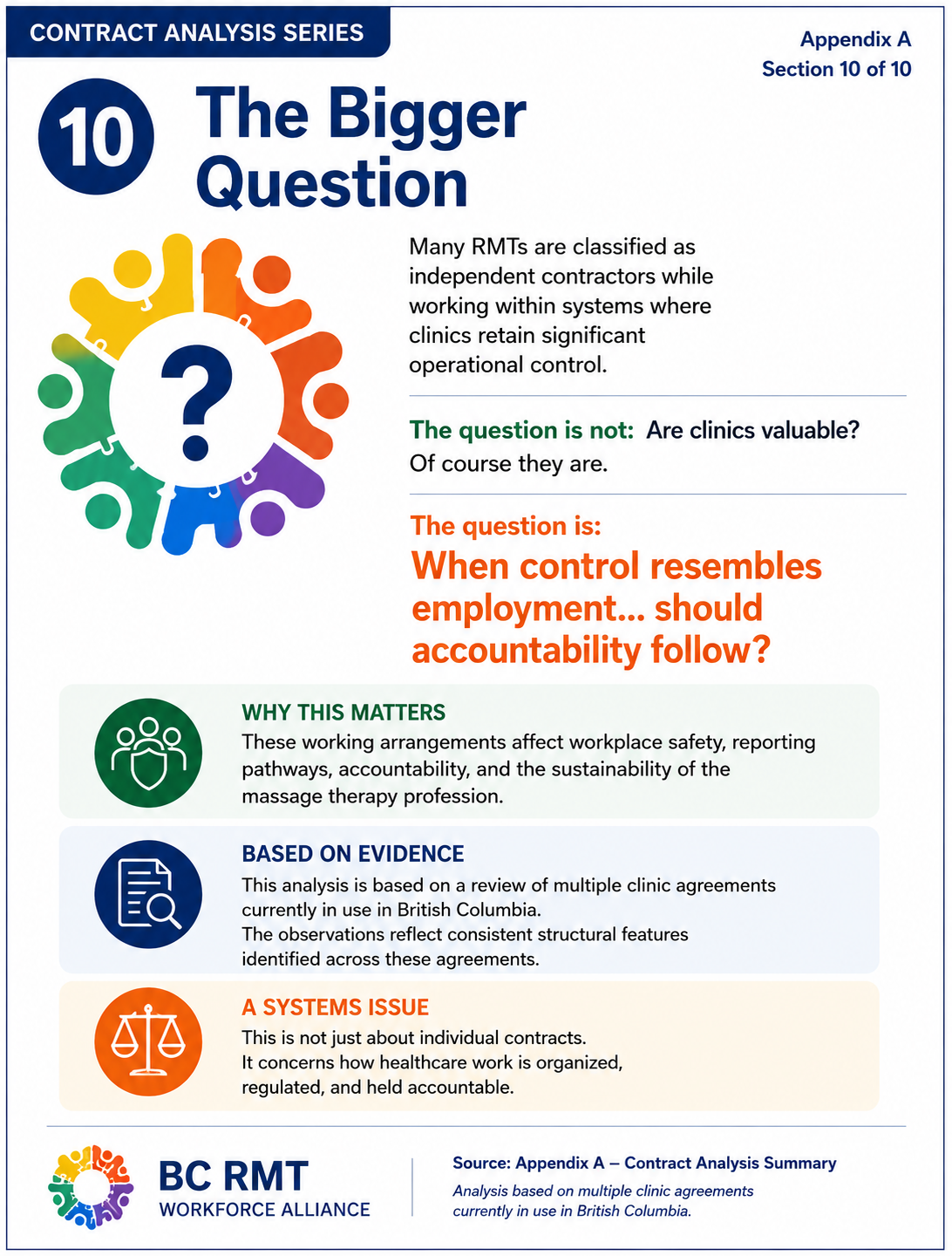
Practitioners are commonly classified as independent contractors while operating within structured environments where clinics retain significant control over scheduling, fees, patient access, and operational processes, resulting in blended or unclear accountability structures.
Potential Relevance to Classification Considerations:
The combination of clinic control over key business functions alongside practitioner designation as independent contractors may reflect a misalignment between formal classification and the functional reality of the working relationship.
Plain Language: What This Means
Many RMTs are formally classified as independent contractors but work under conditions where clinics control key aspects of their work, including scheduling, pricing, patient access, and operational processes.
In most industries, when a worker does not control these core elements of their work, they are more likely to be classified as an employee rather than an independent contractor.
This gap between classification and day-to-day reality may affect access to protections, reporting pathways, and the ability of regulators to fully understand workplace conditions.
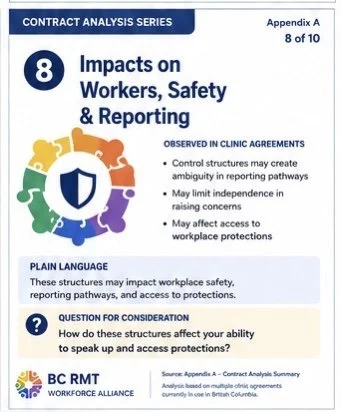
Relevance to Workplace Safety
The structural features outlined above contribute to potential ambiguity in:
• Responsibility for maintaining safe working environments
• Access to reporting mechanisms for workplace incidents
• Alignment with occupational health and safety frameworks
• Responsibility for environmental safety procedures and infection-control practices
• Occupational safety training and workplace hazard management
• Accountability for workplace incidents involving patients, equipment, or environmental conditions
These factors are relevant to the analysis presented in the accompanying workplace safety brief.
These factors may also influence the consistency and reliability of information available to support regulatory oversight and system-level risk identification.
Plain Language: What This Means
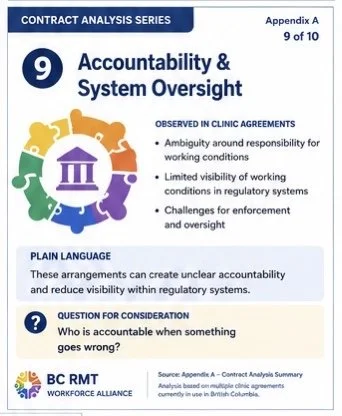
When it is unclear who is responsible for working conditions, safety concerns may go unreported or unaddressed. Practitioners may not know whether to raise issues with the clinic, a regulator, or another body, or may feel unable to do so.
In most employment-based environments, there are clearer systems for reporting and addressing workplace safety concerns. When those structures are unclear or absent, issues may remain hidden.
This can limit visibility into workplace risks and reduce the effectiveness of systems intended to protect both practitioners and patients.
Relevance to Labour Classification Considerations
The structural features outlined above contribute to potential ambiguity in:
Clarity of responsibility for working conditions within clinic environments
Access to protections typically associated with employment relationships
Consistency in how classification criteria may be applied across similar workplaces
Plain Language: What This Means
The combination of limited control, high integration into clinic operations, and restrictions on independence creates uncertainty about whether current classification practices accurately reflect how the work is performed.
In most industries, classification is based on how a working relationship functions in practice, not just how it is labeled in a contract.
When similar working arrangements are classified differently across workplaces, it may indicate a need for closer examination of how classification criteria are being applied.
Conclusion
The consistency of these structural features across multiple agreements suggests that this model reflects broader professional norms rather than isolated practices. Further consideration of how these working arrangements align with regulatory, legal, and safety expectations may be warranted.
Taken together, these structural features may contribute to reduced transparency, diffuse accountability, and limitations in the flow of information necessary to support effective regulatory oversight.
Potential Relevance to Classification Considerations:
The consistency of these structural features across multiple agreements may warrant consideration of whether current classification practices align with established labour standards frameworks.
Plain Language: What This Means
The patterns described above appear consistently across multiple agreements, suggesting this is not an isolated issue but a common model within the profession.
In most industries, when similar working conditions appear across multiple workplaces, it may indicate a broader structural pattern rather than individual variation.
This may warrant further review to determine whether current working arrangements align with labour standards, workplace safety expectations, and the goals of effective regulatory oversight.