
Are BC RMTs Actually Self-Employed?
Most Registered Massage Therapists in British Columbia think they are classified as independent contractors.
But in Canada, employment status isn’t determined by what a contract says. It’s determined by how the working relationship actually functions.
This distinction matters for taxes, legal protections, financial risk, and professional autonomy.
And it raises an important question: Are BC RMTs truly operating as independent contractors or something else?
Most RMTs aren’t choosing between employee vs contractor benefits, they’re working in roles that don’t cleanly meet the criteria for either.
What Defines an Independent Contractor in Canada?
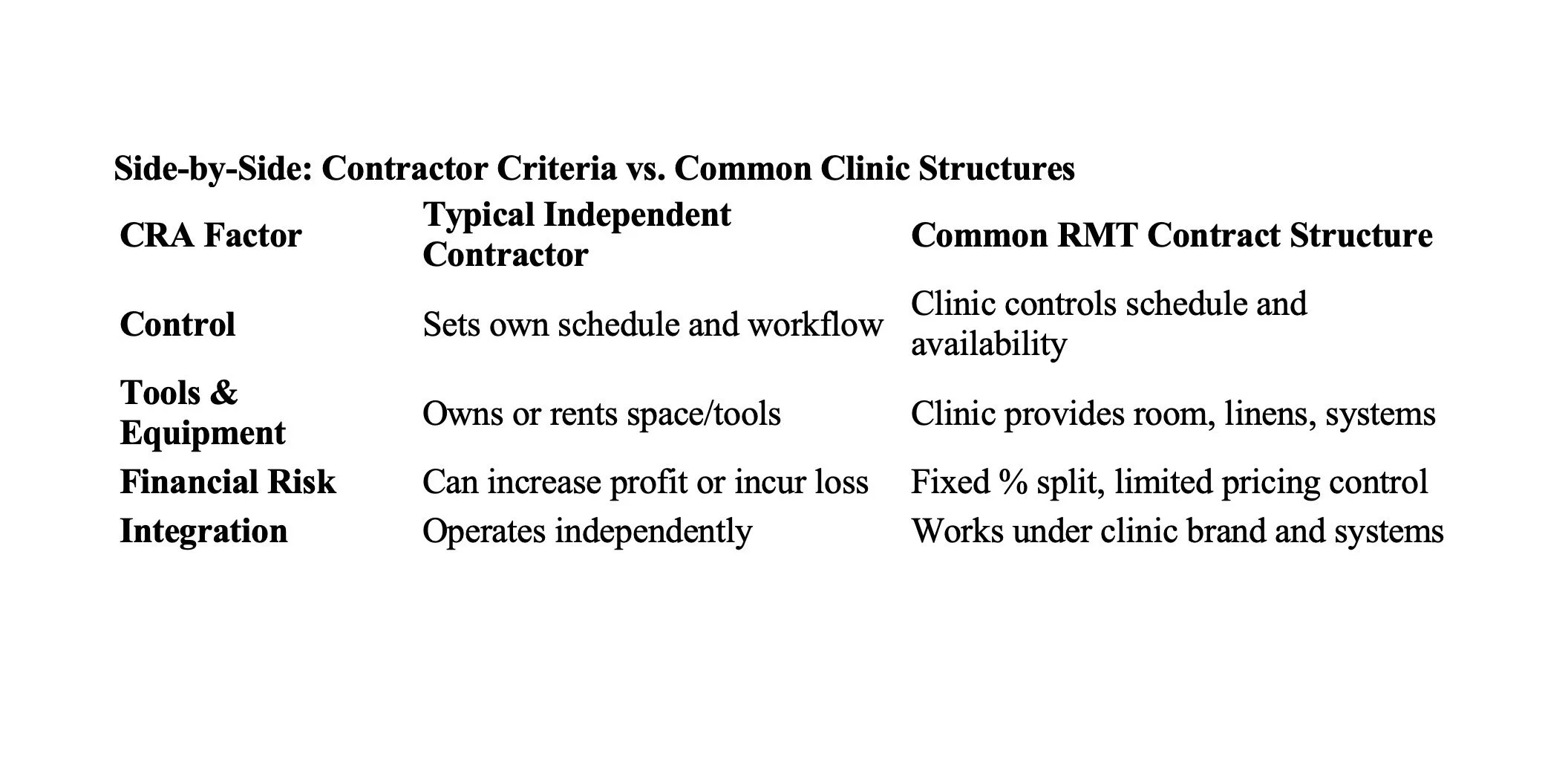
According to the Canada Revenue Agency, employment status is assessed based on the actual nature of the working relationship, not just the written agreement. While no single factor is decisive, four key elements are typically considered:
Control (who determines how and when work is performed)
Ownership of tools and equipment
Chance of profit / risk of loss
Integration into the business
These criteria are used across industries - not just healthcare.
How Does This Compare to Common RMT Contracts?
Many RMT contracts in BC include provisions such as:
Set schedules controlled by the clinic
Restrictions on working elsewhere
Limitations on advertising or independent business activity
Revenue splits with centralized billing
Use of clinic space, systems, and equipment
Non-solicitation or non-competition clauses
When viewed through the CRA framework, this creates an important tension.
Make it stand out
Whatever it is, the way you tell your story online can make all the difference.
A Practical Checklist For RMTs:
You may want to take a closer look at your classification if:
You do not control your schedule
You cannot set your own fees
Payments are processed through the clinic
You are restricted from working elsewhere
You cannot take patients with you when leaving
If 3+ of these apply, it may be worth seeking clarification on how your role is classified.
A Practical Checklist For Clinic Owners:
This isn’t just a practitioner issue - it’s also a structural and compliance consideration.
Factors that may increase classification risk include:
High levels of control over contractor schedules and operations
Restrictions that limit independent business activity
Centralized control of billing and revenue flow
Long or broad non-compete clauses
In some cases, this may expose clinics to:
Reclassification risk
Retroactive tax implications
Legal challenges around enforceability
Why Has This Model Become So Common? This structure didn’t emerge from bad intent.
It reflects an attempt to balance:
administrative efficiency
consistent patient experience
shared infrastructure
financial sustainability
However, over time, the model has become normalized - even where it may not fully align with how contractor relationships are defined.
This isn’t just a technical distinction.
It affects:
Access to employment protections
Financial risk and stability
Professional autonomy
Business development opportunities
Long-term sustainability within the profession
For many RMTs, there is a growing gap between how the work is labeled and how the work actually functions
Access to Labour Protections and Workplace Safety
How a working relationship is classified doesn’t just affect taxes or contracts, it can also influence access to broader labour protections and workplace safety frameworks. In British Columbia, employees are generally covered under established systems that support:
workplace safety standards and protections
access to benefits such as vacation pay and statutory protections
employer contributions to programs such as CPP, EI, and WorkSafeBC
Independent contractors, by contrast, are typically responsible for managing these elements themselves.
When working relationships fall somewhere in between > where there is significant control but limited access to employee protections > it can create uncertainty around:
who is responsible for workplace safety obligations
how risks are managed and shared
what protections are realistically available to the practitioner
Greater clarity in classification has the potential to:
improve access to existing worker protections
support safer, more transparent workplace environments
reduce ambiguity for both practitioners and clinic owners
better align responsibilities within established legal frameworks
This is not about limiting flexibility, but about ensuring that working relationships align with the protections and responsibilities that already exist within the system.
Why This Matters for Clinics, Too.
This isn’t just a practitioner issue. Clinic owners are also navigating real and often competing pressures, including:
maintaining consistent patient care
managing administrative workload
covering overhead and operational costs
recruiting and retaining therapists
In many cases, the current model reflects an attempt to balance these demands within a challenging business environment. However, when working relationships are unclear or misaligned, this can create downstream effects for clinics as well:
High therapist turnover, which increases recruitment and onboarding costs
Disruption to patient continuity and retention
Ongoing administrative burden associated with constantly training new practitioners
Difficulty building long-term, stable teams
Over time, this can contribute to a “revolving door” dynamic that is frustrating for both clinic owners and therapists, and ultimately impacts patient experience. Greater clarity and alignment in working relationships has the potential to improve not only compliance and transparency, but also stability and sustainability at the clinic level.
In some cases, the very controls that are intended to create stability within a clinic may also contribute to classification challenges under existing frameworks.
What Would a More Aligned Model Look Like?
There are generally two clear and compliant pathways:
1. True Independent Contractor Model
RMT controls:
schedule
pricing
patient relationships
RMT bills clients directly (or retains control of billing relationship)
Clinic provides space/services in exchange for:
flat rent, or
clearly defined service fees
2. Employment Model
Clinic controls:
schedule
pricing
operations
Clinic assumes:
employer obligations (CPP, EI, vacation pay, etc.)
RMT works as an employee within that structure
The Key Issue: A model that combines employer-level control with contractor-level risk does not align cleanly with Canadian classification frameworks.
Moving Forward
This is not about assigning blame. It’s about improving clarity. Greater awareness of how working relationships are defined can help:
RMTs make informed decisions
Clinic owners reduce risk
The profession move toward more sustainable, transparent models
A Note to Colleagues
If you’ve ever felt uncertain about your classification, or struggled to reconcile your contract with your day-to-day reality, you’re not alone. This conversation is just beginning. Understanding patterns across clinics is an important step toward improving clarity and alignment within the profession.
If you’re an RMT or clinic owner with insights, contract structures, or experiences you’re willing to share, I welcome thoughtful, professional dialogue.
My goal is to better understand how these models are being used across the profession and where there may be alignment, or misalignment, with current classification frameworks.
Part 2: Contractor Or Employee? A Closer Look At Working Relationships For BC RMTs
Related Articles:
Position Brief: Misclassification of RMTs in BC
Who is Advocating For BC RMTs? Examining A Systemic Gap In The Profession
Contract Analysis of Work Agreements For BC RMTs
Safety Brief: Workplace Safety Risks & Structural Implications Of Current Work Arrangements For BC RMT