
Truckers “Drivers Inc.” Share Misclassified Workers Woes With BC RMTs
CBC: The Trucking Industry's "Driver Inc." Story Felt Surprisingly Familiar
The federal government's planned crackdown on the trucking industry's "Driver Inc." scheme immediately caught my attention.
As I read the article, I couldn't help but notice the similarities between the issues surrounding worker misclassification in the trucking industry and the concerns I've been researching within allied healthcare over the past several months.
The professions themselves are very different. The work, the risks, and the public safety considerations are different. The underlying issue of worker misclassification, and many of the structural consequences that flow from it, are remarkably similar.
Worker misclassification produces predictable downstream consequences regardless of industry.
According to the CBC article, trucking companies have been classifying drivers as independent contractors while exercising a level of control that many argue more closely resembles an employment relationship. In announcing new funding to address the issue, Jobs Minister Patty Hajdu stated:
"Misclassification is exploitation. It strips workers of their rights, and it creates an uneven playing field."
That statement reflects an important shift in the public conversation.
For years, worker misclassification has often been discussed primarily as a tax issue. Increasingly, it is being recognized as a labour issue, a workplace safety issue, an occupational health issue, a public safety issue, an accountability issue, and an issue of fair competition.
That broader conversation is long overdue.
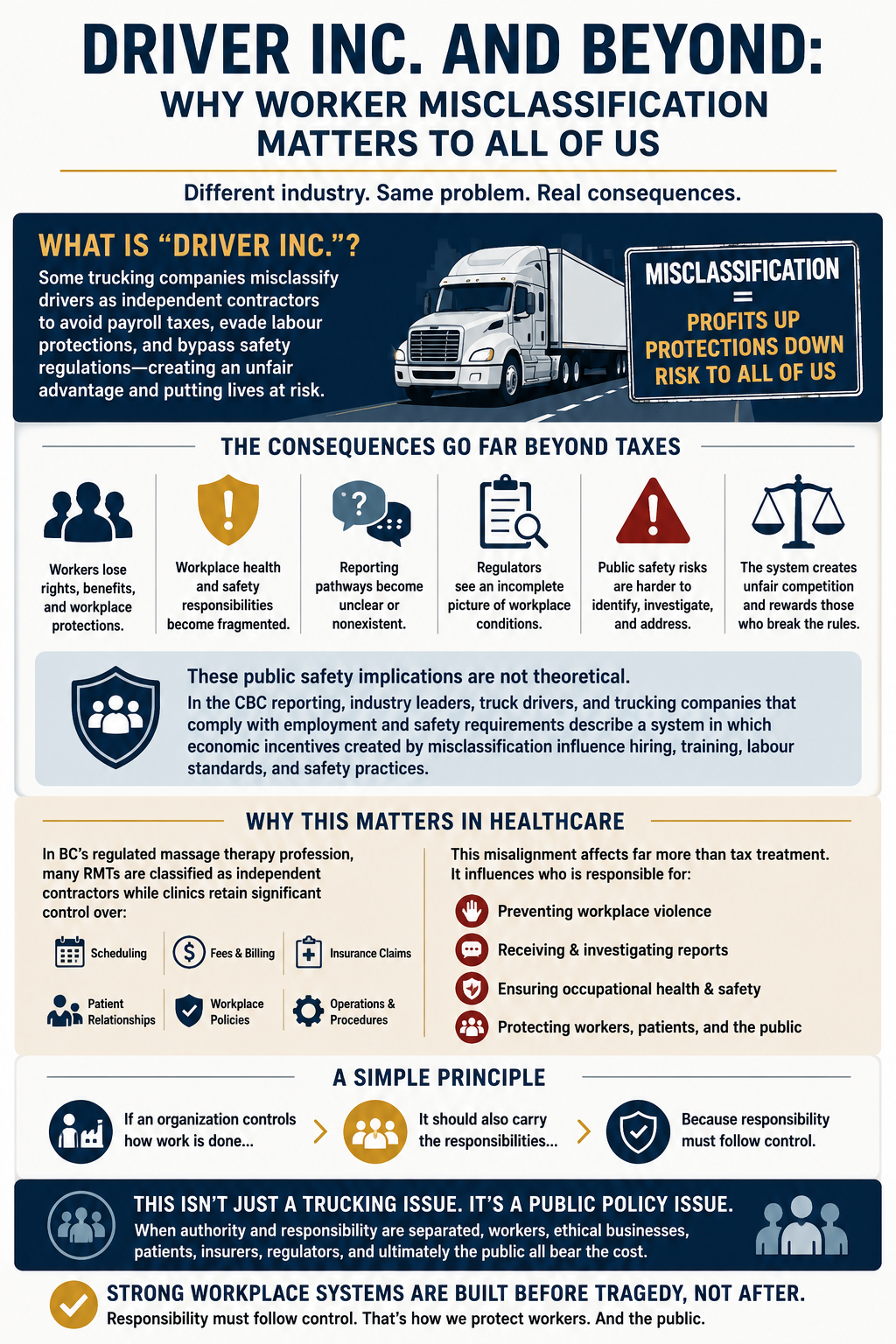
Misclassification Doesn't Stop at Taxes
Much of the public discussion around "Driver Inc." focuses on lost tax revenue, payroll deductions, and unfair competition. Those issues matter, but taxation is only one consequence of misclassification.
The Canadian Trucking Alliance argues that the consequences extend much further. Workers lose labour protections. Companies that comply with employment laws and tax obligations struggle to compete with organizations that avoid those responsibilities. Workplace safety suffers. Public safety is put at risk.
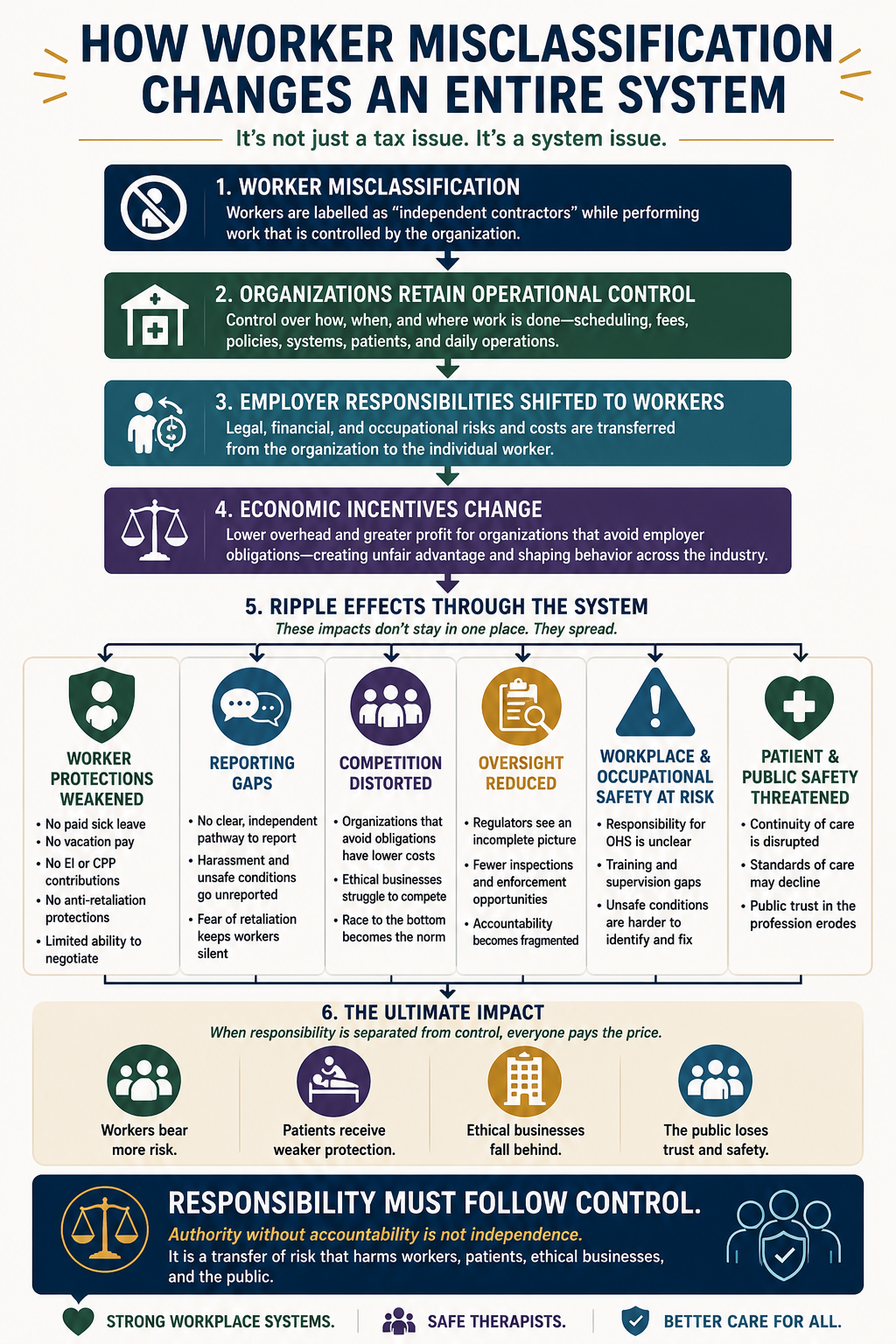
Misclassification doesn't simply change how workers are paid.
It changes the incentives operating throughout an entire industry.
Organizations that avoid employer obligations gain a financial advantage over businesses that comply with employment standards, payroll taxes, workplace safety requirements, and other legal responsibilities.
Those incentives influence hiring.
Compensation.
Training.
Workplace safety.
Reporting behaviour.
Competition.
Regulatory oversight.
And ultimately, public trust.
Misclassification separates operational control from legal responsibility. That separation creates accountability gaps affecting worker protections, workplace safety, occupational health, taxation, regulatory oversight, and ultimately public trust.
When organizations retain the authority to control how work is performed while transferring legal, financial, and occupational responsibility onto workers, the consequences extend far beyond payroll taxes.
Workers lose rights, benefits, and workplace protections.
Responsibility for occupational health and safety becomes fragmented.
Reporting pathways become unclear or nonexistent.
Regulators receive a less complete picture of workplace conditions.
Public safety risks become more difficult to identify, investigate, and address.
The public safety implications are not hypothetical. In the CBC reporting, industry leaders, truck drivers, and compliant trucking companies describe a system in which economic incentives created by misclassification may influence hiring, training, labour standards, and safety practices.
Responsibility must follow control.
Authority without accountability is not independence. It is a transfer of risk from organizations onto workers while accountability becomes fragmented.
Why This Matters in Healthcare
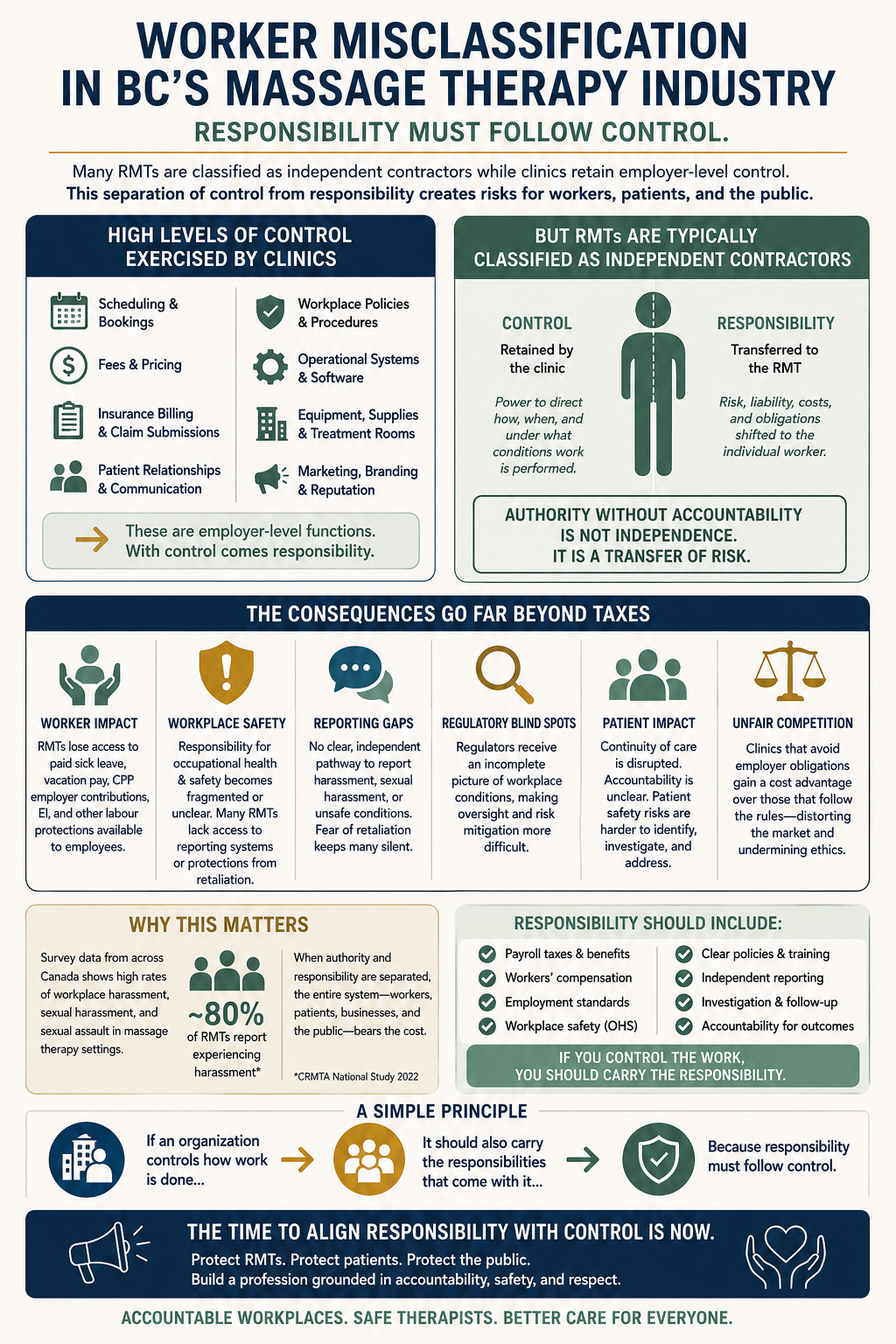
Over the past several months, I have been examining working arrangements within BC's regulated massage therapy profession.
Across multiple clinic agreements, RMTs are commonly classified as independent contractors while clinics retain substantial control over scheduling, fees, billing systems, insurance claim submissions, patient relationships, workplace policies, operational procedures, and many other core aspects of practice. These recurring structural patterns formed the basis of my Contract Analysis, Workplace Safety Brief, and Misclassification Brief.
National and provincial survey data has documented high rates of workplace harassment, sexual harassment, and sexual assault within the massage therapy profession. Yet many practitioners continue to work without many of the workplace protections, occupational safety systems, reporting mechanisms, and anti-retaliation processes commonly found in traditional employment settings.
The consequences extend beyond the practitioners themselves.
Worker classification influences who is responsible for workplace violence prevention.
Who receives reports of unsafe conditions.
Who investigates those reports.
Who implements corrective action.
Who bears legal responsibility.
How regulators understand workplace conditions.
How insurers steward health benefit plans.
Whether businesses that comply with employment obligations can compete fairly with those that do not.
And ultimately, how effectively the public is protected.
Control and Responsibility Belong Together
Across labour law, occupational health and safety, and healthcare, responsibility generally follows control.
If an organization controls scheduling, bookings, billing, insurance claim submissions, patient relationships, workplace policies, pricing, equipment, and the day-to-day operation of a business, it is exercising employer-level control over how work is performed.
Organizations that retain that level of operational control should also bear the corresponding responsibilities, including payroll obligations, employer tax contributions, workplace safety, occupational health and safety, workers' compensation coverage, employment standards, and the other legal obligations that accompany directing the work of others.
This is not simply a question of fairness between workers and organizations.
It is also a question of maintaining a level playing field for businesses that comply with labour laws, occupational safety requirements, payroll obligations, and employment standards.
When one business model externalizes those responsibilities while another accepts them, the competitive landscape itself becomes distorted.
That concern sits at the heart of the trucking industry's Driver Inc. campaign.
It should also prompt reflection in other industries where similar working arrangements exist.
Authority and accountability should not be separated.
A Familiar Timeline
Another part of the CBC article resonated with me.
The Canadian Trucking Alliance reported that it has been raising concerns about Driver Inc. since 2018.
Eight years!
That timeline should prompt reflection.
Structural problems rarely appear overnight.
More often, they become normalized.
Workers adapt.
Industries adapt.
Regulators receive incomplete information.
By the time an issue reaches the national news, the underlying structural problems have often existed for years.
Meaningful reform almost always begins the same way: people documenting recurring patterns, asking uncomfortable questions, and refusing to accept the appeal to tradition, "that's just how the industry works", as an adequate answer.
When billions of dollars flow through an industry, the financial incentives to preserve existing business models are substantial. Structural reform rarely encounters resistance because no one benefits from the status quo. It encounters resistance because significant economic interests are involved.
Different Profession. Similar Principle.
The trucking industry and regulated healthcare are very different sectors.
The professions are different.
The principle is not.
When organizations retain operational control while transferring legal responsibility elsewhere, accountability becomes fragmented regardless of industry.
Those consequences extend beyond workers.
They affect ethical businesses.
Insurers.
Regulators.
Patients.
And ultimately the public.
When does an independent contractor arrangement stop functioning as an independent business?
When organizations exercise employer-level control, should they also assume employer-level responsibilities?
How should worker protections, occupational safety, public safety, and regulatory accountability operate when authority and responsibility become separated?
Those are not trucking questions.
They are not massage therapy questions.
They are public policy questions.
And they deserve to be discussed wherever similar structures exist.
Final Thoughts
One of the most encouraging aspects of this story is not simply the government's response.
It is seeing worker classification recognized as a matter of public policy rather than a private contractual dispute.
Because misclassification is not simply about taxes.
It changes incentives.
It influences competition.
It affects worker protections.
It shapes workplace safety.
It influences public safety.
It determines who carries the risk.
Who receives the protections.
Who bears responsibility.
And whether our labour, occupational safety, and regulatory frameworks continue to reflect the realities of modern work.
Responsibility must follow control.
When it does not, workers, ethical businesses, patients, insurers, regulators, and ultimately the public all bear the cost.
CBC Article: Crackdown on ‘out-of-control’ trucking loophole promised in upcoming federal budget - ‘Driver Inc.’ scheme involves companies misclassifying drivers to save on taxes. By Ben Andrews
CBC Article: Ever heard of Driver Inc.? Canada's trucking industry is calling it a $1B scam. By Robyn Miller
Canadian Trucking Alliance Editorial: EDITORIAL: The True Cost of Trucking Lawlessness & The Endless Empty Narratives
Appendix A: Contract Analysis For BC RMTs
Misclassification of RMT Workers & Workplace Violence: Safety Brief